
Click on image to enlarge
Well . . .
Here’s the deal. I know what ultimately became of Mary, more about this in a bit. But . . . there is a significant 10-year gap where she is (sigh) still “missing.” Her gap years are 1935 and 1937 - 1946. The 1930 US Federal census and Mary’s Social Security Application (SS-5), completed and signed by Mary in 1936, place her in Mifflinburg, Union County, Pennsylvania and in Allentown, Lehigh County, Pennsylvania respectively.
Here’s the deal. I know what ultimately became of Mary, more about this in a bit. But . . . there is a significant 10-year gap where she is (sigh) still “missing.” Her gap years are 1935 and 1937 - 1946. The 1930 US Federal census and Mary’s Social Security Application (SS-5), completed and signed by Mary in 1936, place her in Mifflinburg, Union County, Pennsylvania and in Allentown, Lehigh County, Pennsylvania respectively.
In the Missing Ancestor Report - UPDATE the attached flyer included a plea to please contact
me if anyone had information about Mary’s whereabouts, or had information that could
help further the “investigation” (research) and help me re-unite Mary’s “leaf”
with her family tree. After publishing
the blog and flyer, I received many supportive comments and emails. There were several who did some sleuthing and
I’d like to thank you ALL. Special gratitude to two in particular – Elmer
and Marilyn whose clues yielded results.
Okay,
here is what I now know about Mary. To
recap, for those that may be new to Family Preserves, Mary Telthia LINDSEY was
born in York, York County, Pennsylvania, 2 January 1908, to Walter Cleveland
LINDSEY and Marguerite (AKA Margaret) Ethel LEARN. Walter and Marguerite were living at 181 East
Cottage Place, York, York County, Pennsylvania, at the time of Mary’s birth.1 In 1910, Mary, her brother Walter and her
parents were living at 35 South Street, York City, York County,
Pennsylvania. And, in November of that
same year, Mary had a new baby brother, William (Bill) Gordon LINDSEY; they
were still living in the same home.2 Over the intervening years,
1911 – 1919, the Lindsey family is living at: 3
1911: 938 East Philadelphia Street, York, York County, Pennsylvania
1913: 561 West Clark Avenue, York, York County, Pennsylvania
1915: 143 East Maple, York, York County, Pennsylvania
1917: 529 MacKenzie, York, York County, Pennsylvania
1919: 305 North West Street, York, York County, Pennsylvania
Mary’s parents were divorced by 12 June 1919.4 And, by 1920 the children were separated; Mary living in Upper Allen Township, Cumberland, Pennsylvania, with the Emmanuel Crone family, with whom she lived until the age of 18.5 Mary’s siblings, Walter Galloway LINDSEY is living with the Beard O. Sharretts family in Cumberland Township, Adams County, Pennsylvania;6 William Gordon LINDSEY is living in the Children’s Home of York and York County, York County, Pennsylvania;7 and Maretta Grace LINDSEY is living with her adoptive parents, M. H. and Catherine Bailey, in Shrewsbury Township, York County, Pennsylvania.8 And, their father, Walter Cleveland LINDSEY can be found still living at 305 North West Street, York, York County, Pennsylvania.9 After their divorce, Marguerite “farmed out” her two eldest children to work local farms and to earn their room and board. She placed the two youngest children in the York & York County Children’s home, located in York County, Pennsylvania; Bill would live there until the age of majority and Maretta would be adopted by the Bailey’s soon after her arrival at the home. The US Federal 1930 census shows that Marguerite married her third husband, Robert J Harris at the age of 33; Marguerite was born 1887 making their wedding year 1920. I have, however, not been able to locate the Harris’ in the US Federal 1920 census.10



1911: 938 East Philadelphia Street, York, York County, Pennsylvania
1913: 561 West Clark Avenue, York, York County, Pennsylvania
1915: 143 East Maple, York, York County, Pennsylvania
1917: 529 MacKenzie, York, York County, Pennsylvania
1919: 305 North West Street, York, York County, Pennsylvania
Mary’s parents were divorced by 12 June 1919.4 And, by 1920 the children were separated; Mary living in Upper Allen Township, Cumberland, Pennsylvania, with the Emmanuel Crone family, with whom she lived until the age of 18.5 Mary’s siblings, Walter Galloway LINDSEY is living with the Beard O. Sharretts family in Cumberland Township, Adams County, Pennsylvania;6 William Gordon LINDSEY is living in the Children’s Home of York and York County, York County, Pennsylvania;7 and Maretta Grace LINDSEY is living with her adoptive parents, M. H. and Catherine Bailey, in Shrewsbury Township, York County, Pennsylvania.8 And, their father, Walter Cleveland LINDSEY can be found still living at 305 North West Street, York, York County, Pennsylvania.9 After their divorce, Marguerite “farmed out” her two eldest children to work local farms and to earn their room and board. She placed the two youngest children in the York & York County Children’s home, located in York County, Pennsylvania; Bill would live there until the age of majority and Maretta would be adopted by the Bailey’s soon after her arrival at the home. The US Federal 1930 census shows that Marguerite married her third husband, Robert J Harris at the age of 33; Marguerite was born 1887 making their wedding year 1920. I have, however, not been able to locate the Harris’ in the US Federal 1920 census.10
We
know from the US Federal 1920 census that Mary is living with the Crone family
on their farm located in Upper Allen Township, Cumberland County,
Pennsylvania. Emmanuel Crone is the Head
of Household. His wife, Minnie;
daughter, Laura; and Grandson, Chester Lancaster are also living in the
home. In the Missing Ancestor Report - UPDATE I noted that the grandson of Mary’s sister
Maretta uploaded a photo of Mary, dated 1926.
It is my belief that the photo may be Mary’s graduation picture. In that post I noted that the Mechanicsburg
Area Senior High School (MASH) served several communities to include the
borough of Upper Allen Township. I did
an initial search for MASH 1924 – 1926 yearbooks online at E-Yearbooks.com and
Classmates.com; no luck. My search for
yearbooks continued. I contacted the
Mechanicsburg Area Senior High School and spoke to the school librarian. The earliest yearbook that the school library
has in their collection is 1930. I then contacted
the Joseph T. Simpson Public Library in Mechanicsburg and learned from the
Librarian the following . . .
“What
we have pre-1930 is a 1926 yearbook and a 1920 Commencement Booklet that does
list the names of some of the younger classes (not the entire class list
however). Unfortunately, I’ve looked through both of these items and have not
found your Grand Aunt’s name! I have a
sneaking suspicion that she somehow fell in the ‘gap’ that these two items do
not cover.”
I had learned from the MASH school
librarian, that a retired teacher, within the district, purchased a home from
which he operates the Mechanicsburg Historical Archives. It was suggested I reach out to him to see if
he might have the MASH school yearbooks for 1924 – 1926; Bill got back with me
a short time later. Unfortunately, he
did not have those years in his yearbook collection. I next reached out to the Mechanicsburg Area
Senior High School Alumni on their Facebook Group of the same name and learned
of a local Mechanicsburg restaurant, Dieners, located at 135 West Main Street
Mechanicsburg, Pennsylvania that has a collection of MASH yearbooks on
display. It was suggested that it might
be worth contacting them to see if they had the yearbooks for the years I’m
looking for. This is still on my “to-do”
list.
This brings us to reader
contributed clues.
After reading the Missing Ancestor Report - UPDATE , Elmer contacted me after having spent some
time sleuthing. Using what we did know,
Elmer discovered Mary in the Reclaim the Records, NYC Marriage Index – Staten
Island 1945 – 1946 at Archives.org.
And, Marilyn too, using what we knew, discovered
an obituary for Mary’s sister Maretta.
The obituary mentioned a sister, Mary Perugini. YAY!!!
Using these two promising clues I requested the marriage record; a
three-page document consisting of the application, the affidavit, and the
marriage license, from New York City.
Here is what I learned.
On 14
January 1946 Mary and Richard H. Davis applied for license to marry. The groom was living at 35 Andrews Street,
South Beach 5, Staten Island, New York.
Richard was 30 years of age, born 8 November 1915 and employed as a
seaman. He was born in Newton, Massachusetts
and his parents are Roscoe W Davis, born in the United States and Anne Curtin
also born in the United States. Richard had
not been previously married.
Mary
Telthia LINDSEY lived at 35 Andrews Street, South Beach 5, Staten Island, New
York. She was 38 years of age, born 2
January 1908 and employed as a waitress.
Mary was born in York, Pennsylvania and her parents were Walter G. [C]
LINDSEY, born in the United States, and Margarita [Marguerite] Ethel LEARN,
born in the United States. Mary had been
previously married once before. Her
former husband was Marland C. Rudy and he, at the time of Mary’s and Richard
Davis’ application for marriage, was still living. Mary and Marland Rudy were divorced 7 January
1946 in Richmond County, New York. The
grounds for divorce? Adultery. According to the application for marriage,
Marland Rudy was served a summons in Meflinburg [Mifflinburg], Pennsylvania and
did not appear in court in person; an attorney did not appear on his behalf or
file for a waiver. John J. Demane,
Deputy City Clerk, solemnized the rites of matrimony, 16 January 1946 in the
presence of Mary’s daughter, D. Marie Rudy and Joseph A. Diminico.11
This IS my Mary! YAY!!
Mary records her father’s name as Walter “G” LINDSEY. Her father’s name was actually Walter
Cleveland LINDSEY. However, her brother’s
name was Walter Galloway LINDSEY. Mary
didn’t grow up with her father, she was 12 when her parents divorced, it is
reasonable to assume that she either didn’t know her father’s middle name or
perhaps forgot it. Whereas, Mary had recently,
between 1941 – 1946, briefly reconnected with her brother, Walter, so perhaps
when recording her father’s name on the license and affidavit she mistakenly
wrote her brother’s, rather than her father’s, middle initial.
Mary states
that her former husband, Marland Rudy, was served a court summons in “Meflinburg”
Pennsylvania. Marland was born,12
and indeed lived, the majority of his life in Mifflinburg, Union County,
Pennsylvania,13 except for a stint in the U.S. Army14 and
his death in a New Jersey Tuberculosis Sanatorium, in 1953.15

To Do: Order a copy of the divorce records.
Remember, I still have no
clue as to Mary’s whereabouts 1935 and 1940 – 1946. Now having the name of Mary’s 2nd
husband, Richard H. Davis, and learning from their marriage records that she
and Richard are living at 35 Andrew Street, South Beach 5, Staten Island and
recognizing that to be the same address that my Grandmother, Mary’s
sister-in-law, recorded on the back of this photo.

Click on image to enlarge

Click on image to enlarge
I
now wondered if Mary and Richard might be found together at that Staten Island
address in the US Federal 1940 census?
No such luck. I was not able to
find Mary anywhere in Staten Island, New York.
I searched by the address, 35 Andrews Street, South Beach, Staten
Island, New York; using her maiden name, Mary T. LINDSEY; using her married
name Mary T. Rudy; using the name she recorded on her 1936 Social Security
Application (SS-5), Marie T. LINDSEY-Rudy;16 and though I knew from
the New York City marriage records that Mary and Richard were not yet married
in 1940, I still searched for Mary using the name Mary T. Davis. I also searched for Richard H. Davis in
Staten Island, New York. Nothing! I did however, find Richard H. Davis living
with his parents in Belmont, Middlesex, Massachusetts on 35 Alma Avenue. He was living in the same household in 1935.17 I searched all 367 of Staten Island, Richmond
County, New York’s enumeration districts image-by-image . . . nothing!
I
should note here that I also looked for Mary in Allentown, Lehigh County,
Pennsylvania, as that is where she was living and working at the time she
applied for her social security number.
No luck. And, I did the same here,
searched all 72 of Allentown, Lehigh County, Pennsylvania’s enumeration districts
image-by-image. And, I also searched for
626 Chew Street, Allentown, Pennsylvania as that was her address in 1936. And, I broadened the search. I looked for any
Mary T. LINDSEY, Mary T. Rudy, Marie T. LINDSEY-Rudy and Mary T. Davis in any
town or city in the United States. You
can imagine with a common name such as Mary and common surnames such as LINDSEY,
Rudy, and Davis the daunting task. I
didn’t find her.
Had
Mary returned to her husband and daughter, is she perhaps with them in
1940? No. Marland Rudy is living with his daughter
Doretta M. and his parents, Elmer C. and Emma J. Rudy, in Mifflinburg, Union
County, Pennsylvania. The date was 10
April 1940. According to The Daily Item,
Sunbury, Pennsylvania, dated 23 August 1940, Marland accepted a carpenter
position in Valdosta, Lowndes, Georgia.18 And, on 16 October 1940,
Marland reported to the Local Draft Board No. 1 Lowndes County, Georgia. The address that Marland provides is 303 East
Savannah Avenue, Valdosta, Lowndes, Georgia.
He indicated that the person “who will always know your address” was his
father, Elmer Charles Rudy.19
I also looked to see if Mary could be found in 1940 with her mother,
Marguerite and her husband Robert J. Harris.
No. Robert and Marguerite are living
in Philadelphia, Pennsylvania at 1628 Sydenham Street. 20
Lastly, I also looked to see if Mary had returned to the Upper Allen Township or Mechanicsburg area, where she had grown up with the Crone family. No.
Lastly, I also looked to see if Mary had returned to the Upper Allen Township or Mechanicsburg area, where she had grown up with the Crone family. No.
As noted
previously, Family Preserves reader, Marilyn, ran across an obituary for Mary’s
sister, Maretta Grace LINDSEY Ziegler, that ran in the Thursday, 12 August 1982
York Daily Record, York, Pennsylvania, on page 7. The obituary states “she was the daughter
of the late Walter C. and Margaret LEARN LINDSEY. Additional survivors are: . . . a sister,
Mary Perugini, Staten Island, New York; three brothers, William LINDSEY, New
Jersey; Maurice Bailey, Mount Joy, and Walter LINDSEY.”21

Click on image to enlarge
This IS my Mary! Mary’s and
Maretta’s parents, Walter C. LINDSEY and Margaret LEARN are identified, as are
their brothers, Walter LINDSEY and William LINDSEY. Maurice Bailey? The Bailey family had adopted Maretta circa
1920.
So, by 1982 Mary is
remarried. Did she and Richard Davis
divorce? Or, did Richard pass away? When did Mary remarry?
To Do:
- Look for divorce and/or death records for Richard H. Davis
- Look for New York City / New York marriage record for Mary and [?] Perugini
So where in
the WORLD did Mary Telthia LINDSEY Rudy go? Mary, PLEASE STOP being so
contrary!!
But . . . there’s a silver lining!!! I found Mary’s granddaughter! Note, to protect her privacy, I will only
refer to her as “A.” I was able to
locate her via social media and reached out to her, sending her a letter
introducing myself (hoping that she didn’t think I was a crazy loon!). I included a copy of the Missing Ancestor Report - UPDATE . And, she phoned!!! We had a lovely
conversation - getting to know one another and sharing information. I learned . . .
- Mary’s third husband’s name was Arthur Perugini
- Mary had reconnected with her mother, Marguerite and, at the time of Marguerite’s death, Mary invited her step-father Robert Harris to live with her family
- Mary died 28 January 1983 in Staten Island, Richmond County, New York (I’ve requested a copy of Mary’s death certificate from New York City. I will have to wait though until the city’s government offices are open and operational again.)
And,
“A” has thoughtfully remembered me, when she recently discovered some of Mary’s
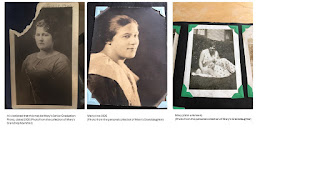
old photos and scrapbooks. With her permission, I've posted a couple of them here. There are three that we believe to be Mary, but "A" wasn't sure. Looking over them closely and also asking for a "second opinion" from an unbiased party, the conclusion is we "believe" the photos in question to be her. Click on image to enlarge.


Sadly, she does not know where Mary was in 1940; she too thought she must have been in
Staten Island.
I thought
about marking this “case” solved, but I am a huge proponent of striving to meet
the Genealogical Proof Standard (GPS) of an exhaustive research – leaving no
proverbial stone unturned – and with Mary still “missing” in the “gap” years of
1935 and 1940 – 1946, I must continue to try and find her.
In
addition to looking for her in the US Federal 1940 census, I’ve looked to see
if she might be listed in the city directories for Allentown, Lehigh County, Pennsylvania;
Philadelphia, Philadelphia County, Pennsylvania; Mifflinburg, Union County,
Pennsylvania; Upper Allen, Cumberland County, Pennsylvania and Staten Island, Richmond
County, New York for the gap years in question. No such luck.
I’ve also searched the usual newspaper online sites – Newspapers.com;
Genealogybank.com; and ChroniclingAmerica.com. Nothing!
To Do:
Search the newspapers at Fultonhistory.com
If you are interested in a challenge, I welcome another set of eyes on this.
Tracy
Copyright © 2020 Family Preserves; Tracy L Meyers
Copyright © 2020 Family Preserves; Tracy L Meyers
___________________________________________
SOURCES:
1 Ancestry.com,
Pennsylvania, Birth Records, 1906-1908 (Provo, UT, USA, Ancestry.com
Operations, Inc., 2015), Ancestry.com, http://www.Ancestry.com.
Commonwealth of Pennsylvania, birth certificate, (1908), Mary Telthia
Lindsey; Bureau of Vital Statistics, New Castle
2 1910 U.S. census, York County,
Pennsylvania, population schedule, York City, ward 1, enumeration district (ED)
114, sheet 1-A, dwelling 10, family 10, Walter Lindsey; NARA microfilm
publication T624_1435
3 Ancestry.com,
U.S. City Directories, 1821-1989 (Provo, UT, USA, Ancestry.com Operations,
Inc., 2011), Ancestry.com, http://www.Ancestry.com.
1911 page 469; image 239. 1913 page 497; image 246. 1915 page 498; image 252. 1917 page 491; image 233. 1919 page 593; image 301
4 Pennsylvania,
York, Protonotary Court Files, Protonotary 93, April 1919 Docket Entry, scanned
copy. 3 March 1919 Walter C LINDSEY vs Margaret E Lindsey, reference divorce
from Margaret Ethel LEARN.
5 Ancestry.com,
1920 United States Federal Census (Online publication - Provo, UT, USA:
Ancestry.com Operations Inc, 2010. Images reproduced by FamilySearch.Original
data - Fourteenth Census of the United States, 1920. (NARA microfilm
publication T625, 2076 rolls). Records of the Bureau of the Census, Reco),
Ancestry.com, http://www.Ancestry.com, Year: 1920; Census Place: Upper Allen,
Cumberland, Pennsylvania; Roll: T625_1557; Page: 2B; Enumeration District: 43;
Image: 533.
6 Ancestry.com, 1920 United States Federal Census (Online
publication - Provo, UT, USA: Ancestry.com Operations Inc, 2010. Images
reproduced by FamilySearch.Original data - Fourteenth Census of the United
States, 1920. (NARA microfilm publication T625, 2076 rolls). Records of the
Bureau of the Census, Reco), Ancestry.com, http://www.Ancestry.com, Year: 1920;
Census Place: Cumberland, Adams, Pennsylvania; Roll: T625_1507; Page: 2A;
Enumeration District: 9; Image: 200.
7 Ancestry.com, 1920 United States Federal Census (Online
publication - Provo, UT, USA: Ancestry.com Operations Inc, 2010. Images
reproduced by FamilySearch.Original data - Fourteenth Census of the United
States, 1920. (NARA microfilm publication T625, 2076 rolls). Records of the
Bureau of the Census, Reco), Ancestry.com, http://www.Ancestry.com, Year: 1920;
Census Place: York Ward 2, York, Pennsylvania; Roll: T625_1669; Page: 17A;
Enumeration District: 120; Image: 220.
8 Ancestry.com, 1920 United States Federal Census (Online
publication - Provo, UT, USA: Ancestry.com Operations Inc, 2010. Images
reproduced by FamilySearch.Original data - Fourteenth Census of the United
States, 1920. (NARA microfilm publication T625, 2076 rolls). Records of the
Bureau of the Census, Reco), Ancestry.com, http://www.Ancestry.com, Year: 1920;
Census Place: Shrewsbury, York, Pennsylvania; Roll: T625_1668; Page: 1B;
Enumeration District: 91; Image: 586.
9 Ancestry.com, 1920 United States Federal Census (Online
publication - Provo, UT, USA: Ancestry.com Operations Inc, 2010. Images
reproduced by FamilySearch.Original data - Fourteenth Census of the United
States, 1920. (NARA microfilm publication T625, 2076 rolls). Records of the
Bureau of the Census, Reco), Ancestry.com, http://www.Ancestry.com, Year: 1920;
Census Place: York Ward 11, York, Pennsylvania; Roll: T625_1669; Page: 15A;
Enumeration District: 139.
10 Ancestry.com, 1930 United States Federal Census (Online
publication - Provo, UT, USA: Ancestry.com Operations Inc, 2002.Original data -
United States of America, Bureau of the Census. Fifteenth Census of the United
States, 1930. Washington, D.C.: National Archives and Records Administration,
1930. T626.), Ancestry.com, http://www.Ancestry.com, Year: 1930; Census Place:
Philadelphia, Philadelphia, Pennsylvania; Roll: 2116; Page: 10A; Enumeration
District: 721; Image: 111.0; FHL microfilm: 2341850.
11 New York, Richmond, Staten Island, Affidavit for License; Marriage
License; and Marriage Certificate to Marry, City of New York Municipal
Archives, 31 Chambers Street New York, NY 10007, Affidavit for License to
Marry, 0072, 16 January 1946; Richard Harding Davis and Mary Telthia Lindsey.
12 Ancestry.com, U.S. WWII Draft Cards Young Men, 1940-1947 (Lehi,
UT, USA, Ancestry.com Operations, Inc., 2011), Ancestry.com,
http://www.Ancestry.com, The National Archives at Fort Worth, Texas; Fort Worth,
Texas; WWII Draft Registration Cards for Georgia, 10/16/1940 - 03/31/1947;
Record Group: Records of the Selective Service System, 147.
13 Ancestry.com, 1920 United States Federal Census (Online
publication - Provo, UT, USA: Ancestry.com Operations Inc, 2010. Images
reproduced by FamilySearch.Original data - Fourteenth Census of the United
States, 1920. (NARA microfilm publication T625, 2076 rolls). Records of the
Bureau of the Census, Reco), Ancestry.com, http://www.Ancestry.com, Year: 1920;
Census Place: Mifflinburg, Union, Pennsylvania; Roll: T625_1655; Page: 13B;
Enumeration District: 185.
Ancestry.com, 1930 United States
Federal Census (Online publication - Provo, UT, USA: Ancestry.com Operations
Inc, 2002.Original data - United States of America, Bureau of the Census.
Fifteenth Census of the United States, 1930. Washington, D.C.: National
Archives and Records Administration, 1930. T626.), Ancestry.com,
http://www.Ancestry.com, Year: 1930; Census Place: Mifflinburg, Union,
Pennsylvania; Page: 19A; Enumeration District: 0014; FHL microfilm: 2341884.
Ancestry.com,
1940 United States Federal Census (Online publication - Provo, UT, USA:
Ancestry.com Operations, Inc., 2012.Original data - United States of America,
Bureau of the Census. Sixteenth Census of the United States, 1940. Washington,
D.C.: National Archives and Records Administration, 1940. T627), Ancestry.com,
http://www.Ancestry.com, Year: 1940; Census Place: Mifflinburg, Union,
Pennsylvania; Roll: m-t0627-03615; Page: 5A; Enumeration District: 60-17B.
14 Ancestry.com, U.S. WWII Draft Cards Young Men, 1940-1947 (Lehi,
UT, USA, Ancestry.com Operations, Inc., 2011), Ancestry.com,
http://www.Ancestry.com, The National Archives at Fort Worth, Texas; Fort
Worth, Texas; WWII Draft Registration Cards for Georgia, 10/16/1940 -
03/31/1947; Record Group: Records of the Selective Service System, 147.
15 New Jersey, State Department of Health of New Jersey, 244 E
Hanover Street, Trenton, NJ, Death Certificate, 20228, 13 May 1953; Marland
Rudy.
The Daily
Item, Sunbury, Pennsylvania (online archive), "Marland C Rudy, Former
Mifflinburg Man, Dies," 14 May 1953, accessed 8 September 2019, obituary
for Marland C Rudy.
16 Social Security Administration, Applications for Account Numbers,
Form SS-5, Marie (Mary) Telthia Lindsey Rudy, 171-03-9334, filed 24 November
1936.
17 Ancestry.com, 1940 United States Federal Census (Online
publication - Provo, UT, USA: Ancestry.com Operations, Inc., 2012.Original data
- United States of America, Bureau of the Census. Sixteenth Census of the
United States, 1940. Washington, D.C.: National Archives and Records Administration,
1940. T627), Ancestry.com, http://www.Ancestry.com, Year: 1940; Census Place:
Belmont, Middlesex, Massachusetts; Roll: m-t0627-01603; Page: 9B; Enumeration
District: 9-69.
18 "Many People Now Visiting Mifflinburg; Other Items," 23
August 1940, accessed 11 September 2019, Marland Rudy. Marland Rudy accepted a
position in Valdosta, GA, as a carpenter. https://www.newspapers.com/, The
Daily Item, Sunbury, Pennsylvania, online images (https://www.newspapers.com).
19 Ancestry.com, U.S. WWII Draft Cards Young Men, 1940-1947 (Lehi,
UT, USA, Ancestry.com Operations, Inc., 2011), Ancestry.com,
http://www.Ancestry.com, The National Archives at Fort Worth, Texas; Fort
Worth, Texas; WWII Draft Registration Cards for Georgia, 10/16/1940 -
03/31/1947; Record Group: Records of the Selective Service System, 147
20 Ancestry.com, 1940 United States Federal Census (Online
publication - Provo, UT, USA: Ancestry.com Operations, Inc., 2012.Original data
- United States of America, Bureau of the Census. Sixteenth Census of the
United States, 1940. Washington, D.C.: National Archives and Records
Administration, 1940. T627), Ancestry.com, http://www.Ancestry.com, Year: 1940;
Census Place: Philadelphia, Philadelphia, Pennsylvania; Roll: T627_3750; Page:
6A; Enumeration District: 51-2025.
21 Maretta G. Lindsey Ziegler, 12 August 1982, accessed 23 August
2019. https://www.newspapers.com/, York Daily Record, York,
Pennsylvania, online images (https://www.newspapers.com).

