Showing posts with label Starr. Show all posts

30 April 2017

In Plain Sight!

This post is the fourth in a series about my research in solving the two-part history mystery of . . . Who IS Eva; Eva Ramer? Or, Eva PFAFF?  And, who is George PFAFF? You can read the previous posts in the series by clicking any one of the following links: Grandma Isn't Playing Nice; The Grandparents Are Out of Control!; and Grandma, A Little Cooperation . . . PLEASE!!

Well, we “know” from my last post, Grandma, A Little Cooperation . . . PLEASE!, that Eva, is Eva PFAFF.  And, that conclusion was based on A LOT of research and the piecing together of original and derivative sources; records that recorded primary and secondary information based on direct or indirect knowledge.

I noted in my last post, that as I was writing it, I was again re-reviewing my information, documents and sources.  And, that I had made some “discoveries” that I hadn’t noticed in the . . . oh, I don’t know . . . the first 100 times I had read, reviewed, and transcribed; read, reviewed; and then, read and reviewed the documents and sources, yet again!!  Let me just say here, there is no such thing, as going through and over something too many times.  You WILL, always . . .  ALWAYS . . . find something that you’ve missed; misread; didn’t give importance to; gave too much importance to; misinterpreted; failed to appreciate the significance of, etc., etc.

Let me say it again . . .

there is no such thing, as going through and over something too many times.  You WILL, always . . . ALWAYS . . . find something that you’ve missed; misread; didn’t give importance to; gave too much importance to; misinterpreted; failed to appreciate the significance of, etc., etc.

This simply cannot be stressed enough!!!

So . . . as I was writing my last post, I was again reviewing my research, and even though I had browsed page-by-page each of the census records for each of the counties; Berks, Bucks, Carbon, Montgomery, and Lehigh.  Going through each city / town / borough looking for ALL PFAFF families and noting any young males in those households that fit the approximate age of George – the gentleman named as the “father” of Eva on several documents, I decided yet again, that I would search the census records one more time.  What the heck, probably fruitless, right?!!  After all, I had thrown everything, “but the kitchen sink” into each of my previous searches!!  And, I had gone through all those census records, in all of those counties, in each and every town, borough and city, page-by-page and hadn’t found him!  But, hey, what the heck, I’ll throw in the “kitchen sink” this time!!! 

In the blog post dated, 19 September 2015, The Grandparents are Out of Control!, the marriage announcement, “SQUIRE SNYDER TIES A HYMENEAL KNOT,” which ran in the Allentown Democrat, Wednesday, 8 June 1892, announced the wedding of Eva’s mother, Louisa MILHEIM and a gentleman by the name of Oscar Ramer.  This wedding announcement is NOT announcing the marriage of Eva’s parents.  While Louisa is Eva’s biological mother; Oscar is most certainly not the biological father. We know this because, the wedding between Louisa and Oscar took place a full three years and four months after Eva’s birth.  Eva’s birth certificate records her parents as Louisa MILHEIM and George PFAFF.  The 1900 US Federal Census records Eva PFAFF, age 11, living in her grandparents’ - Charles and Mary MILLHIME - home, located in Hokendauqua Village, Whitehall Township, Lehigh County, Pennsylvania. Eva’s marriage license records her maiden name as Eva PFAFF.  The Allentown Democrat announced, 20 May 1911, the marriage between Eva PFAFF and George E. W.STARR. And, Eva’s death certificate records her father’s name as George PFAFF; Eva’s daughter, Catherine, provided that information.

While I was confident in my conclusion that Eva was NOT Oscar Ramer’s daughter and that our mystery guy, George PFAFF, indeed was Eva’s father, I still didn’t have enough “proof.”  I wasn’t exhausted!  Nor, had I looked I at, or through, every record set or data collection.  I hadn’t gone through every archive; repository; church; cemetery; funeral home or library.  There was still a lot more, A LOT more that I needed to do.  I needed to aspire to that Genealogy Proof Standard (GPS) of a “reasonably exhaustive search.”  Did I think I’d find anything that would alter my conclusion?  No, not really.  However, I needed to be open-minded enough to be open to that possibility – the possibility that I could find something that definitively proved me wrong and take me in a different direction.  I was okay with that.  After all, my goal was, has been, and is, to research my family; my ancestors, and to document their life and lives.  I don’t want to chase after a person or family that isn’t mine. 

So, my next step was to hire a professional genealogist to do “on site” research in Lehigh County, Pennsylvania.  While I would have loved to travel home to my home state and the stomping grounds of my youth, my schedule and some other things – life! – simply didn’t permit it.  So, contracting with a professional genealogist in the ancestral geographical area of interest, and requesting additional documents and local archive searches, was the best alternative.  And, I was able to learn and discover some interesting things that both furthered my research and ultimately, supported my conclusions. 

My specific research focus for the professional genealogist was to visit the Lehigh County courthouse and locate the courthouse file and docket reference the fornication and bastardy case for Oscar Ramer; Session: January 1892, page 592, No. 26.  My contract was for five hours of research, plus expenses.  However, he agreed, that if time permitted – that is, the focus of his (my) research was achieved – he’d search the courthouse records for a marriage license for George PFAFF and Louisa MILHIEM.  I believed, IF a marriage took place, it would have been between 1888 and 1889.

The following information was included in the genealogist’s research notes.

“Lehigh County Court of Quarter Sessions Docket Book “J” provided index and file No. 26.  This entry from January Session, 1892, dated 5 January, stated that Oscar Ramer had posted a $500.00 bond to guarantee his appearance at the next criminal court session which would have been in April 1892.  At that time he would have to answer the charges brought against him by the Commonwealth of Pennsylvania.”

The genealogist noted that there are two sources of records for these Quarter Court Sessions:

  1. The Session Docket Book which included the index of the names of the defendant along with a short entry providing a brief description of the proceedings.
  2. The associated paper file that might include actual full transcripts of what occurred in the courtroom

The genealogist noted that Docket book “J” included entries through January 1892.  And, the following Docket book “K” began with entries beginning in January 1895.  He could find no explanation for why this gap of three years existed in these Docket book entries.  In his speaking with the courthouse clerks, he learned this problem had never been previously discovered in these records.

Well, of course not; is anyone surprised that it was in the research of MY family that this “problem” was discovered?  Ugh, I know that I am not the only family genealogist that feels that way when researching their family.  If I am helping a friend or co-worker, all the pieces of the puzzle – err, records – just fall into place; but my family?  Nope, can’t have that!!  What fun would that be?!!

The genealogist did review the microfilm of the original court file papers for January Session 1892 through the January Session 1893.  He noted that the entry for Oscar Ramer, file #26 case should have appeared in April 1892.  Even if it had been continued to a later session, he believed it certainly would have been resolved prior to January 1893.  He found no entries for Ramer, file #26.

The genealogist noted possible reasons why no later appearance of the Ramer court case were found:

  1. The original paper file was lost
  2. The conflict between the mother and the accused father was resolved out-of-court prior to the scheduled court date in April 1892

Now, for a point of clarification.  I did not suspect that this 1892 court case, for charges of fornication and bastardy had anything to do with Eva and her parentage.  Remember, Eva, was already three years old by January 1892.  What was more likely, the charges were for a more recent event; Louisa MILHEIM’s pregnancy with daughter Mamie, who was born, 25 April 1892, while this court case was still being decided / settled. 

The genealogist suspects, in the absence of a court case, that Oscar Ramer and Louisa MILHEIM negotiated an agreement before the continuance date in April 1892. 

Louisa’s and Oscar’s daughter, Mamie, was born in April 1892 and they were married in June 1892; is there any doubt as to what agreement was reached during the negotiations?

The genealogist then turned his attention to Oscar and Louisa’s marriage license and he noted . . .

“The license application states both Oscar and Louisa were single.  If Louisa had been previously married and widowed or divorced, the application should have listed her as such, not single.”

I noted that the genealogist’s findings supported my conclusions.  Although I had shared with him what records and information I had, and where I had already looked, my conclusions based on my research were purposefully omitted so as not to bias his findings.

“So . . . as I was writing my last post, I was again reviewing my research, and even though I had browsed page-by-page each of the census records for each of the counties; Berks, Bucks, Carbon, Montgomery, and Lehigh.  Going through each city / town / borough looking for ALL PFAFF families and noting any young males in those households that fit the approximate age of George – the gentleman named as the “father” of Eva on several documents, I decided yet again, that I would search the census records one more time.  What the heck, probably fruitless, right?!!  After all, I had thrown “everything, but the kitchen sink” into each of my previous searches!!  And, I had gone through all those census records, in all of those counties, in each and every town, borough and city, page-by-page and hadn’t found him!  But, hey, what the heck, I’ll throw in the “kitchen sink” this time!!!”

So, what do you think happened?
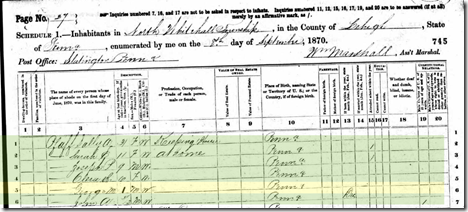
8 September 1870 - US Federal Census - George Pfaff

  • 1870 US Federal Census @ Ancestry.com
  • Note, David PFAFF, Head of Household is listed on the last line of the previous page and not shown here

Do you see the kitchen sink?!! 

Picture me doing the genealogy dance; accompanied by a hoot and a holler!!  There’s George (!) on the 1870 US Federal Census; recorded on 8 September 1870 living in Slatington, Lehigh County, Pennsylvania with his family.  He’s one.  His parents are David PFAFF and Sally. 

Wait, what?  Hold that thought for a minute; I’ve seen this before.  I’ve seen David’s name before.  Where are my research notes?  My notes record that I found this same family in the 1880 US Federal Census, living in Catasauqua, Lehigh County, Pennsylvania.  The Head of Household was recorded as “Dana;” followed by Sally Ann, wife; “Gengrele, son;” and John, son. 

While the enumerator’s handwriting is extremely poor and the transcriber obviously had great difficulty making out the names, I believe, after careful study of the record that “Dana” is DAVID and that “Gengrele” is GEORGE M
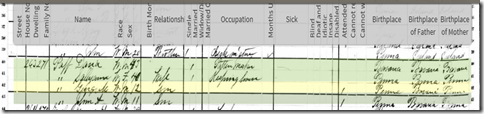
9 June 1880 - US Federal Census - George Pfaff

  • 1880 US Federal Census @ Ancestry.com

I had noted in my research notes that George would have been 21 the year that Eva was born, 1889, making him a candidate for the mysterious “George PFAFF.” A candidate worth looking at further.  Searching the local newspapers of the area; the Allentown Leader published David PFAFF’s obituary in their 9 and 10 June 1908 issues.  And, the Allentown Democrat ran an article, 11 June 1908 honoring his Civil War service; prompting me to search for and subsequently purchase a copy of his Civil War pension file.  I hadn’t found “my George,” but David’s son, George in this 1880 census was a good candidate, not having anything further to go on, I needed this file in my pursuit of researching and reviewing every piece of evidence that could be found to either rule in, or to rule out, any possible George with the PFAFF / PAFF surname that was of the right age, in the right time, and place to be Eva’s father.

While I waited for the National Archives and Records Administration (NARA) to process my request for David’s pension file, I put this research aside and documented Eva’s maternal side; the MILHEIMs.

When I received David’s pension file from NARA, I first read through it – all 69 pages – I then set it aside for just a bit.  When I next came back to it, in a day or so, I transcribed the file in its entirety; word for word.  And, I disappointedly noted at the time, that this wasn’t the PFAFF family I was looking for, there was no record or recording of George anywhere in the file.  So, I filed the record away.  I documented the information it contained and I noted my findings, or lack thereof, in my research notes. This was a case of what the professionals call “negative research;” that, is my research of, and review of the records to this point, yielded negative results.  This “George,” wasn’t “my George.”

When did I review the 1880 US Federal Census?  When did I order, read, review and transcribe the Civil War Pension file for David PFAFF?  I reviewed the 1880 US Federal Census and ordered the pension file in November 2015.  I received,  read, reviewed and transcribed the pension file, January 2016. 

It’s now spring of 2017 and there’s George!  But, this makes no sense.  I looked at this George; this family, a year ago and while on paper it would seem that they were very good candidates for the person and family I was looking for, my subsequent research seemed to indicate otherwise.  So, I don’t get it!  Time for a call to to a good friend in California; we frequently work through research conundrums, issues and strategies together.  I made the call and what she hears on her end is . . .

Holy heck, I found him!

By the way, that’s the “family friendly” version! 

I explained and then said, but, I don’t get it.  I looked at this George!  I looked at this family!  And, while right age, right place; right time fit, it couldn’t be him, because this George wasn’t mentioned in any other record after the 1880 US Federal Census, and David PFAFF, the Civil War soldier, the soldier whose pension file I ordered, didn’t mention George, at all.  So, I had concluded a year ago that this wasn’t THE PFAFFs that I was looking for.

And, my ever patient friend said, “do you still have the pension file?”  Why, yes, yes, I do.  And, we went through it . . . again.  Literally, I read it to her; word for word; line by line.  When I got to . . .

“Have you any children living? If so, please state their names and the dates of their birth.”

And, David listed his children. 

I kept reading.  But, my friend said STOP!  Go back and read that again.  Okay . . .

“Have you any children living? If so, please state their names and the dates of their birth.”

And, David listed his children. 

I kept reading.  Again, my friend says . . . STOP!  Read it again . . .

“Have you any children living? If so, please state their names and the dates of their birth.”

And, David listed his children. 

And, I again, continued reading.  And, my friend says . . . “No!, Tracy, take a minute and think about what that sentence says!  One, one thousand; two, one thousand; three, one thousand; four, . . . Holy . . . he’s DEAD!!! 

Can, you just picture my friend on the other end saying . . . “ding, ding, ding!  And, WE have a winner!!”

Son of a . . . err . . . gun!  That  means I’ve had the answer to who George PFAFF was; who Eva’s father was, for over a year!!  One . . . whole . . . entire year!! 

He WAS in PLAIN SIGHT!!  And, yet . . . I had missed him!! 

This is why we take copious and detailed research notes.  This is why we document both positive and negative research.  This is why we read, review, and transcribe ALL documents. This is why we “collect” all same name persons and families when we are looking to sort out who is who in a genealogy history mystery.  This is why we cite our sources, so that, in the advent we need to retrace our steps to determine why we did or didn’t do something; why we did or didn’t rule out someone, we can retrace our steps to the documents that we used to base our opinions and conclusions on.  Wash, rinse and repeat many, many times.  I cannot stress enough, and I am constantly reminded of this all the time; when researching, ALWAYS, ALWAYS, take the time to periodically go back through your research – your notes, documents, timelines, etc., etc.  from the beginning! – Do NOT SKIP THIS VITAL PROCESS!  Oft times, the “brick walls” we encounter are those of our own making.  Let me remind you . . .

One entire year!  Fifty-two weeks, 365 days, 8,760 hours, 525,600 , minutes, and 31,536,000 seconds.  And, . . . I had him . . . all along!  He was in plain sight, and . . . I missed him!!

We, genealogists – as a community – could successfully apply for any brick mason’s job.  Experience?  Oh, we have experience!!!

We’re really good at building walls . . . walls that are impenetrable.  Walls that are indestructible; walls that will stand for years, decades and centuries!

Personally, though, as a genealogist, I’d much rather have the skill set of an “explosive technician;” a person that is skilled in construction demolition – you know, bringing down those brick walls. Nope, not one brick at a time; all at once – turning them into sand!!!

So, mystery solved?  Yes.  But, another one surfaces; what happed to George?  Why didn’t anyone beyond my grandmother, Eva’s daughter, know about her father?  They didn’t even know his name? I’ll fill you in; watch for a future post.

This questionnaire, a quarterly payment review,  in the pension file was completed by David PFAFF, 4 May 1898.  Eva was born in January 1889; George PFAFF was still living, at the very least, nine months prior to that!  By the time his father, David, completed this questionnaire in 1898, George was deceased.  Well, that’s a nine year window I now have to work with.

Now, misery loves company, so please tell me that I am not the only one who has missed the obvious.  Have any of your ancestors been hiding in plain sight?  I’d loved to hear your stories and how you ultimately discovered what was there the whole time.

Tracy

Copyright © 2017 Family Preserves; Tracy L Meyers

21 June 2015

Grandma isn’t Playing Nice! . . . On Either Side

Okay, here’s the deal, we were all new once . . . right?

When I initially started “collecting” family stories and information in the “dark-ages” before computers and digitization - before I had discretionary funds to send for records or travel to archives - I pretty much knew the present-day and not too distant past stories and details of the living and the recently deceased family members - I had grown up with them, visited them and knew where they lived and worked. 

So, in 2003, when I started tracing their genealogy and family history in earnest, I documented what I knew and started a tree sapling on Ancestry.com.  And, I made the decision early on, that because I had the most information on my mother’s paternal ancestors, I would document what I knew on them, but would not linger - I’d come back to them later.  What I really wanted to get to and discover was the genealogy and family history of my other three grandparents; I didn’t know much beyond them.

I started with the basics, I had birth and death certificates and U.S. Army Discharge papers for my Dad’s Dad; a death certificate for both my mother’s Mom and Grandmother and for her Dad; and, I also had the obituary clipping for my Dad’s Mom.  And, of course, their family stories – the stories I had grown up listening to.  I entered the basic details gleaned from these documents and stories into each one of their profiles and then set about collecting the basic records to document and substantiate their lives and the details that I had.

Reminder . . . this was before I had learned to really focus on each word and line of a document.  Before I had learned the benefits of transcribing a document – even if it was clearly written and easily read – to ensure that I paid attention to every small detail.  Before I knew to create a timeline for each family member so that I could see potential gaps in their lives, the missing vital statistics and details of their lives, and to note any conflicting information.  Before I knew to really focus on what documents I had and which ones were missing.  Before I knew to both pay attention to source information – where that information came from and who provided it – and, to cite – document – the source.  And, before I had discovered the Barefoot Genealogist, Crista Cowan, and her tutorials on the Ancestry YouTube channel and all the tips and tricks I’d learn from her.  Before I learned to document “negative” research – search results that didn’t yield any further information; new information; or that completely debunked the information I had – so that I wouldn’t “climb” the wrong family tree.  Before I learned about blogs and online webinars where I’d continue to learn how to document my family’s history and genealogy.  Before I started blogging and getting my family’s story online and connecting with “cousins.”  And, before the added dividend of really focusing on the details – the facts, ma’am, just the facts – when creating a blog post on the family member or line that I was currently working.

After, creating the online sapling, I used the initial physical documents to record what I knew about each “leaf” and then I started collecting census records, obituaries, birth and death certificates that I didn’t already have for each family member.  Which brings us to today’s post . . .

My maternal Grandmother, Catherine Louise (STARR) Kriebel’s parents were Eva E RAMER and William E STARR Sr.  And, my Great Grandmother, Eva RAMER’s parents were Oscar RAMER and Louisa MILHEIM.  I knew this because . . .

  1. My mother and her siblings knew each of them and they knew where each of them lived and worked – they had grown up with them and visited them
  2. I knew my Grandmother, Catherine (STARR) Kriebel, I knew her siblings, I knew the house she grew up in.  I visited there often as a child – her brother, Robert STARR lived there with his wife and with his Mother – my Grandmother’s mother – Eva E (RAMER) Starr 
  3. I had the physical copy of the obituary for my Grandmother, Catherine STARR; the physical copy of the death certificate for my Great Grandmother, Eva E (RAMER) Starr; the death certificate (found online) for my Great Great Grandmother, Louisa MILHEIM and a copy (found online) of the marriage license for Louisa MILHEIM and Oscar RAMER 
  4. I had US Census records for each ancestor and their family unit from their birth through 1940

And, each of of these substantiated what I already knew – names, dates of birth, marriage, death and residence.  Nothing was amiss.  Or . . . was there?

I didn’t have my Grandmother Catherine (STARR) Kriebel’s birth certificate, I ordered it and waited.  Now, I knew that Catherine’s parents were William E STARR and Eva E RAMER, but when I received the copy of her birth certificate via US Postal Service, it was very generic – provided the child’s name, date and place of birth and parent’s names.  The certificate read . . .

Name:  Catherine Louise STARR

Date of Birth: 1 December 1912
Place of Birth:  Allentown, Lehigh, Pennsylvania

Father: William E STARR
Mother: Eva Pfaff

Well, that isn’t right, my Great Grandmother’s name was Eva E RAMER.  Must have received this in error.  Trash!  And, I moved on.  Yes, now, I am hanging my head in shame, but remember, I was just getting started and I hadn’t yet learned.  We’ll return to this in a bit.

Next I spoke to and “interviewed” my Mother’s cousin Marty.  Marty is Robert STARR’s daughter, and Robert is the half-brother of my Grandmother, Catherine, the son of my Great Grandfather William E STARR and his first wife, Ethel Lynda Kline, and the step-grandson of my Great Great Grandparent’s Louisa MILHEIM and Oscar RAMER.  She was able to provide very few additional details, but I did learn when her father, Robert, passed away – my family had been living overseas at the time and we weren’t aware – sadly, after the death of my Grandmother in 1975 and the busyness of daily living, our families didn’t stay in touch. 

I went looking for Robert’s obituary.

Robert’s obituary was published 6 June 1992 in The Morning Call (Allentown, PA) and named his parents . . .

“William E and Eva E (MILHEIM) STARR”

Wait, that isn’t right!  Where did that come from?  Eva E RAMER and William E STARR are the biological parents of my Grandmother, Catherine, but, William E STARR and Ethel Lynda Kline are the parent’s of my Grandmother’s half-brothers, William E STARR, Jr and Robert STARR.  Okay, by this point, I had learned that I needed to “sure-up” my research if there was a discrepancy.  Everything else in the obituary was consistent with what I knew from first-hand knowledge of growing up with my Grand Uncle.  I made note of the discrepancy and did not yet attach the obituary to Robert’s profile.  I next moved to census records, marriage license(s), death certificates, etc. and set about the task of documenting my family – confirming what I knew, but, with the added task of “proving” or “disproving” the names of Robert’s parents.

Locating the marriage license for William E STARR and Ethel Lynda Kline, the census records for William and Ethel  and Ethel’s death certificate, I was able to “prove” to my satisfaction that both William E, Jr and Robert C STARR were the sons of William E STARR and Ethel Lynda Kline.  Eva E RAMER was their step-mother.  And, I moved on. (we’ll take a look at these documents shortly)

Okay, that research was pretty much all completed back in 2003/4.  In the following years I continued to learn how to research; how to organize my notes; how to create a timeline; how to pay close attention to everything, but particularly to the oddities; how to make note of those oddities, discrepancies, outright errors and “negative” search results; how I should transcribe every document, which in turn helps me focus on all the details; how to do F A N Research; how to create a blog; how to document my searches, so that I didn’t keep searching for those records that I had already found, or, didn’t; how to cite my sources; I learned the basic principals of the Genealogical Proof Standards (GPS); and, I learned research strategies – for me, that meant focusing on one family and surname at a time – to doggedly pursue each leaf and branch, locating “low-hanging” fruit – birth, marriage, census and death records – to include obituaries -  and then diving deeper and locating military records, wills and probate records; land deeds, etc. 

In all honesty, I am still learning about record collections that I haven’t yet explored – why I continue to watch Crista Cowan and other genealogy webinars and why I read a number of blogs.  There is a lot, A LOT of information and educational materials* out there – I cannot encourage you enough to avail yourself of it.  And, most of it, if not all, is in easy to understand (read NOT collegiate) language.  And, that is PERFECT for me.

*To learn more about F A N Research, Citing your Sources and the Genealogical Proof Standards (GPS), click on the hyperlinks (red print).

Since 2004 I have been focused on documenting the BEARSELL, LEARN and LINDSEY - my Dad’s paternal line - families with occasional short forays into the collateral lines, using the F A N Research strategy to help find and document the elusive direct-line ancestors.  Until . . . recently.

Over the past year, the State of Pennsylvania and Ancestry.com have worked together and have recently digitized Pennsylvania’s 1906 – 1963 death certificates.  In doing so, a lot of “shaky leaf” hints have been appearing and distracting my attention.  I’m usually able to stay focused, I don’t, as a rule, tend to get distracted for long.  If my focus on the family / line that I am working on is diverted, it is usually only a brief distraction – one long enough to review the hint and decide whether it is something to keep or can be discarded.  I then refocus my attention to the name / line that I had previously been working.  However . . .

Two weeks ago, a “shaky leaf” hint appeared for my Great Grandmother, Eva E RAMER – the Pennsylvania death certificate.  Okay, I’ll take a look, I don’t expect to find any new information, I’ll just verify that it is her death certificate and I’ll review – in depth - all her source documents when I focus on the RAMER line.  But, wait!  . . .

  1. That doesn’t look like the hard-copy certificate I have
  2. Her parents are listed as George MILHEIM and Louisa PFAFF

Well, that isn’t right.  Eva’s parents were Oscar RAMER and Louisa MILHEIM. 

MILHEIM is right, but it was Eva’s Mother’s maiden name. Who’s George? My Great Great Grandmother’s – Louisa – Father’s name was Charles MILHEIM.  And, PFAFF?  Wait!  PFAFF?  I’ve seen that before.  Oh, I remember, the copy of the birth certificate for my Grandmother – Catherine Louise STARR – that I initially ordered and subsequently threw away, had Eva PFAFF listed as the Mother of my Grandmother.  And, did I mention, that I had on another occasion attempted to obtain another copy of my Grandmother’s birth certificate?  Yes, and when it arrived, it had the same – I assumed – error and . . . you guessed it, I threw it away too. Nope, I hadn’t yet learned.

But, this time, PFAFF had my attention.  Everything else on my Great Grandmother’s death certificate was correct - home address; city and state; date and place of birth; date and place of death; and spouse’s name.  The informant?  My Grandmother, Catherine Louise (STARR) Kriebel and her physical address was also correct.

I knew this information to be correct because I knew my Grandmother and where she lived – I visited her there often – and while I didn’t know either of my Great Grandparents, I did know where they had lived and died – my Grand Uncle Bob (Robert E STARR) and his wife, Ann, lived there – and I visited them often.  So, back to my original question, where did George MILHEIM and Eva PFAFF come from? 

It’s 2015 and by now I had learned the lessons mentioned above.  So much for briefly looking over the hint and “storing” it for when I began work in earnest on the RAMERs.  I couldn’t just put it aside, I needed to, at the very least, research why the PFAFF surname kept appearing – three times is more than a coincidence.  What was I missing?

I went back and looked at the document I had on Eva’s death – remember, I thought, or, perhaps more accurately, assumed, it was a copy of her death certificate.  When I looked at it, I now realized it was a copy of the Local Registrar’s Certification of Death.1  And, it did not include the names of her parent’s.  Nor did it note her maiden name.

5 January 1959 - Registrar's Certificate of Death - Eva Ramer

The document provides my Great      Grandmother’s name as Eva Elizabeth STARR and the place of death as 548 Noble Street, Norristown, Montgomery County, Pennsylvania.  It also provides her date of birth, 24 January 1889 and her date of death as, 5 January 1959.  This is all accurate.  Eva’s step-son and my Grandmother Catherine’s half-brother, Robert and his wife lived in the home he was raised in.  The home, for which the address is provided on the certification of death.  And, as I’ve said, I visited there many times.


5 January 1959 - Death Certificate  - Eva Ramer

The death certificate2 provides the place of death and the deceased’s usual residence (where deceased lived) as 548 Noble Street, Norristown, Montgomery County, Pennsylvania.  The document also provided Eva’s . . .

  • Full Name:  Eva Elizabeth STARR
  • Full Name of Spouse:  William E STARR
  • Date of Birth: 24 January 1889
  • Date of Death: 5 January 1959
  • Father’s Name: Geo MILHEIM
  • Mother’s Maiden Name: Louisa PFAFF
  • Informant:  Mrs. Wilmer KRIEBEL of Schwenksville, Pennsylvania

Mrs. Wilmer KRIEBEL is my Grandmother, Catherine STARR.  She was married to Wilmer, my Grandfather.

Hmm, Grandma isn’t playing nice!

Next I looked at the marriage license3 for my Great Great Grandparents Louisa MILHEIM  and Oscar RAMER.  It provides the . . .  

31 May 1892 - Marriage License - Oscar Ramer

  • Man’s Name: Oscar REMER (variant of RAMER)
  • Woman’s Name: Louisa MILHEIM
  • Age of Man: 23
  • Age of Woman: 23
  • Residence of Man: Whitehall Township, Lehigh County, Pennsylvania
  • Residence of Woman: Whitehall Township, Lehigh County, Pennsylvania
  • Parents’ Name – Man: Eli REMER
  • Parents’ Name – Woman: Charles MILHEIM

Nothing amiss here; all what I had grown up hearing around the dinner table.

What I initially find made me realize that I’d need to employ the F A N (Family / Friends, Associates, and Neighbors) research method and go through both the 1880 and 1900 US Federal Census for Lehigh County, Pennsylvania.  I will need to document the RAMERs, MILHEIMs, and PFAFFs prior to Eva’s birth.  What this means is, I will need to “collect” all families with these surnames and save them in my ancestry “shoebox” and then, I’ll need to go through ALL of the townships and enumeration districts within the county, page by page.  I know that I’ll have to compare each individual within a family and each family in order to sort this out.  And, I also know that I’ll have to pay close attention to the neighbors as well.  And, too, I need to go back over the census records that I had previously saved back in 2003/4.

And, collecting all instances of these surnames within the townships and enumeration districts of Lehigh County, Pennsylvania is what I have been doing, as time permitted, these past two weeks. For statistical purposes, the 1880 US Federal Census for Lehigh County, Pennsylvania had 31 townships, 56 enumeration districts and 1,385 images.  And, the 1900 US Federal Census for Lehigh County, Pennsylvania had 36 townships, 67 enumeration districts and 1,920 images.  FUN!!

Having gone through all 3,305 images of the 1880 and 1900 US Federal Census records for Lehigh County, Pennsylvania and collecting all instances of the RAMER, MILHEIM and PFAFF surnames – including variant spellings – I am now ready to review and dissect each and figure this mystery out.  Thanks Grandma!!

I will return soon and share what I’ve learned.

COMING SOON . . .

Will my real Great Grandmother, Eva E. . . RAMER. . . MILHEIM . . . PFAFF please stand up!

PS:  I hope that I am not the only one that learns the hard way.

PPS: And, my paternal Grandma?  Well, she isn’t playing nice either!  She was the informant on her brother’s death certificate and, she said that he was married.  Ummm, no he wasn’t. . . NEVER!  Sigh, that will have to wait until I’ve sorted through this.

Tracy

Copyright © 2015 Tracy L Meyers

________________________________________________________

Sources:

1Norristown, Pennsylvania, Certification of Death, no. 545557 (1959), Eva Elizabeth Starr; Norristown Local Registrar of Vital Statistics, Cherry Street

2Commonwealth of Pennsylvania Department of Health, Death Certificate 6852 (1959), Eva Elizabeth Starr; ancestry.com, online

3Pennsylvania County Marriages 1855 - 1950 Index and Images (Family Search), "Pennsylvania, County Marriages, 1885 - 1950," index and images, FamilySearch (https://familysearch.org/pal:/MM9.1.1/VF43-NG5 :, Date License acquired: 31 May 1892 / Date of Marriage: 31 May 1892. FamilySearch (https://familysearch.org/pal:/MM9.1.1/VF4V-782).

31 July 2014

Scrapple Nirvana . . . Almost

It has been 39 years since I enjoyed scrapple as much as I did today.  Thirty-nine!  My Grandmother, Catherine Louise (STARR) KRIEBEL passed away too soon in 1975; I was twelve, and until today, I haven’t had scrapple that has measured up to the memory of my family’s scrapple recipe . . . well, sort of.

See, a couple of things have been ‘against’ my enjoying scrapple as I did in my youth:

  1. There are many variations of the recipe – as many people there are in the world, that is how many different recipes there seemingly are for scrapple.  And, none taste quite like my family’s recipe.
  2. Grocery store-bought and massed produced scrapple should be left . . . on the scrap heap!
  3. For me to have scrapple that even comes remotely close to what I enjoyed as a child, my Dad must bring blocks – that’s right blocks! – of it down several times a year from Pennsylvania Amish country.  It still isn’t quite like my family’s recipe, but, it is closer.
  4. As I mentioned, I was just 12 when my Grandmother passed away and I didn’t know yet that genealogy, family history and the preservation of family recipes and memorabilia would become a passion!  So, it never occurred to me to ask and ensure that my family’s scrapple  recipe be preserved.  Nor, the recipe for the condiment of choice (Green Tomato Relish) to serve with the crispy-fried scrapple slices.  And, while I have asked over the past 27, of the 39, years all family members that were involved with pig butchering day for the recipe, it would seem that it is . . . lost.  Crying face

CONFESSION TIME:  Every fall, when my uncle brought 2 – 3 slaughtered pigs from his farm to my Grandparent’s home in Schwenksville, Pennsylvania, we all gathered for a day of butchering; my Grandparents, their children, Carolyn; Richard; Barbara; and Gerry and their respective spouses John; Janet; Durrell; and Jerry and their children would all descend into the basement of the KRIEBEL home.  Well, all except the grandchildren – we had more important things to do. . . PLAY!  So, I never witnessed the process or how the scrapple was made.  Yet, because of my love for my Grandparents and family and because I so enjoyed the fruits of their labor – scrapple, sausage, bacon and . . . oh, my!  I have very fond and treasured memories* of pig butchering days.  Pictures you ask?  I have seen pictures that my Grandmother took of the process,  but just like the recipes, they seem to be lost to me forever.

*hopefully, as family members read this, they will share their memories of pig butchering day in the comments.

Okay, so how did I accidentally achieve scrapple nirvana?  Before I get into that, let’s discuss what scrapple is.  I must say, until I grew up, married and moved from Pennsylvania, I thought that scrapple was a universal food product much like bacon and sausage, it never occurred to me that scrapple – and, what it is – wouldn’t be as well known in other locals.

After a pig is butchered, there is lots of stuff leftover – scraps, including internal organs and intestines - no, no, don’t be scared, when it all comes together, it tastes really good!!  For scrapple these scraps are cooked down into a stew, ground up with the other leftover bits of meat and combined with cornmeal for texture.  The mixture is then cooled down into a loaf, sliced and griddled to serve.  It is most often served for breakfast with eggs and potatoes.  Essentially, you are eating a pork burger with your breakfast.

My passion for genealogy and family history, recipes and memorabilia really blossomed in my late teens and became an addiction after our first child was born in 1988.  I am forever reminiscing about my ancestors, grandparents, my childhood and bygone days.  And, when I get together with fellow Pennsylvanians, scrapple and green tomato relish and how I just can’t find a brand or Amish produced product that measures up to the ‘taste memory’ that I have always seems to come up.  One such conversation some years ago, prompted the father of a dear friend to write down his family’s recipe for scrapple and share it with me.  Here it is . . . (yes, you must continue reading to learn about my nirvana experience.  Smile with tongue out

(1) Cut heads four ways to remove tongue, eyes, ears and also saw off teeth.  Scrape tongue and ears in the hot water to remove hair, then put into tub for pudding meat.

(2) (for pudding) Cook head meat, hearts and kidneys, put in kettle about 10 gallons of water and two handfuls of salt then cook till meat falls from bones, add livers approximately 10 minutes before removing meat from kettle. Juice is saved for scrapple.

(3) Pick the head meat apart while hot, add about 3 medium onions and grind all together with cracklings.  Put about 10 gallons of water in a #2 kettle to cook pudding in, after water comes to boil, cook about 20 minutes, but not too hard a boil as it will burst skins

(4) Using the pudding water, add pig head, juice, season with salt and pepper, add enough water to bring about 6” from top of kettle, add slowly 1-1/2 pounds of yellow corn meal to a batch using about 12 – 15 pounds of buckwheat flour, sprinkle in slowly with hand so it will not lump, stirring continuously.  Bring to a rolling boil and if necessary add 3 – 6 pounds of new lard, so it shows around the edge of kettle.  Boil for about 10 minutes then remove from fire, but continue stirring for about 4 – 5 minutes more.

There are many ways to enjoy scrapple:  with molasses, maple syrup, apple butter, cottage cheese . . . but my Grandmother served it with green tomato relish.  For years, 39, to be exact, I have eaten scrapple plain, which is okay, but . . . I loved it with Grandmom’s relish.  While I have tried store-bought and Amish handmade green tomato relish from all over Pennsylvania and various other locals, none measure up to Grandmom’s recipe.  None!  Mostly because they are all too sweet.  Grandmom’s green tomato relish recipe had just the right ratio of sweet and vinegar – more vinegar - which goes well with the scrapple.  But today, I have had an epiphany that just may have changed my scrapple eating experience for my remaining days . . .

After frying up the ubiquitous Pennsylvania German breakfast of fried scrapple, home fries and eggs, my husband and I sat down at the table for our Saturday breakfast meal.  And,suddenly I had an idea.  I said to my husband, “we have Banana Pepper slices in the refrigerator, I wonder how they would taste with scrapple?”  “It isn’t green tomato relish but, they are jarred in vinegar and an added bonus is that they have a bit of a spicy bite.”  We both said, “hmmm?”  Off to the refrigerator for that jar.  I  piled a couple of slices onto my fried scrapple, gathered a bite-sized piece with a pepper or two and . . . heaven!  Well, sort of.  It wasn’t Grandmom’s relish, I will always miss that, but, it is the only thing in all these years that has even come close to her perfect condiment.

Now, we always have banana peppers in the refrigerator, so please, please tell me, why on earth, did it take 39 years for me to have this epiphany and almost nirvana experience with scrapple heaven?!!!

Now, I know that you are still not too sure about scrapple; you just can’t get passed what goes into it, but consider this.  Scrapple is no longer just a by-product of pig butchering and waste not, want not.  No, really, it has moved up the food chain to seriously good eats!  It has been featured on the Food Network Channel by celebrity chefs. It has been making appearances in restaurants and it is featured at Pennsylvania German and Dutch festivals..

Speaking of restaurants, I recently learned that my hometown peeps have been holding out on me – what’s up with that Chris? – A new restaurant, Greenheart Café, has appeared on the scene in Collegeville, Pennsylvania and was featured in the Times Herald Newspaper in March of this year.  From what I’ve read, they’ve elevated scrapple to gourmet . . . a featured dish on their menu is their Poutine – hand cut French fries with crispy scrapple, freshly made brown gravy, creamy fontina cheese and fresh herbs.  Yes, please!!

So, if you’ve never had scrapple, I encourage you to try it; if you’ve had scrapple and enjoy it, I encourage you to share how you enjoy eating it; if you enjoy scrapple and your family made their own recipe, I encourage you to share what made the recipe uniquely your family’s.  And, I encourage us all to try the elevated and gourmet scrapple dishes that are making appearances on the Food Network Channel, in restaurants and at German and Dutch festivals and to share your culinary experiences. 

For those that may visit Collegeville, Pennsylvania, located in Montgomery County just 1-1/2 hours northeast of Philadelphia, I hope that you’ll visit the Greenheart Café and let me know how you liked the poutine.  And, if you enjoy festivals, I hope you’ll visit the 25th Annual Pennsylvania Dutch Festival next week Thursday, 7 August – Saturday, 9 August 2014; click on the German and Dutch Festivals hyper link above for information.

15 March 2014

One Year–That was Fast!

Well, technically Family Preserve’s  blogiversary was a month ago – 23 February to be exact.

The past ten months were fast-paced.  Filled with lots of research on many different limbs and branches of my family tree.  In December, it all came to a halt.  I had caught up; but worse, I felt as though ‘burn-out’ was setting in.  Just before the holidays I had found one or two documents, I ordered them and then set about waiting.  But try as I might, until this past week or so, I just couldn’t muster a lot of energy or enthusiasm genealogy research.

While I’ve known from the start that I wanted to look back over my first year of blogging - I kept notes on successes, ‘cousin bating’ and the like.  This too failed to initially energize me.  Until this week.

This week I received the documents I had ordered before Christmas and a ‘cousin’ contacted me out of the blue after coming across my blog.  Smile  This has gotten me excited again.  And, I’ve been climbing and exploring my family tree with renewed vigor.

So, here we go, Family Preserves takes a look back on its first year . . .

Total Published Blog Posts February 2013 – March 2014:  34

My Favorite Posts From this Year:

Family / Genealogy Addict

Not the Waltons or the Ingalls

Black Sheep

Missing Ancestor Report

Postive Results:  A direct result of the decision to launch the Family Preserves blog has been positive from the very first.  A few examples of this are highlighted below:

Star Family Preserves launched in February 2013

Star ‘Cousins!’

My research of the BEARDSELLS, LEARN, and McLEAN branches of the family tree yielded ‘cousins!’  ‘Cousins’ is used broadly here and encompasses closer and more distant relationships heretofore unknown.

BEARDSELL  In tracing my Great Grandfather, Wallace BEARDSELL’s,  entry in the US (Port of Philadelphia, Pennsylvania), I discovered that he and his second wife, Clara, had a daughter together.  Lidie Victoria BEARDSELL was my Grandmother’s half-sister.  Sadly, I also discovered that she had passed away one year (2012) before I found her.  She was 99.

LEARN A short time after the launch of Family Preserves, I found myself caring for my father who had just undergone open-heart surgery.  To occupy the hours – mostly to keep from worry – I focused on the LEARN branch of the family tree.  And, through a inquiry on one of many  genealogy FaceBook pages, a ‘LEARN’ cousin reached out.  From that connection I was invited and attended my first LEARN Family Reunion.  A reunion equals an endless sea of ‘cousins!’

McLEAN The McLEAN branch of the tree is a collateral line from which I do not directly descend.  However, the research of this branch helped solve a mystery, which I’ll get into a bit more detail about shortly.

Star Inspired an Interest in Genealogy Both with the launch of Family Preserves and finding more information on the families within our tree, there has been an increased interest among family members, that had not seemed interested in the preceding (20) years.  The results . . .

Photos Largely due to 50th wedding anniversary that my Aunt and Uncle celebrated in April 2013, my other Aunt went through boxes and boxes of photos an slides.  She came across old family albums that my Grandmother had put together and other photographic treasures of both my Grandfather’s (KOONS / KRIEBEL) and Grandmother’s (STARR / RAMER) families. And, she thought of me.  SCORE!!

Family Interest Okay, my husband and I have been married 27 years and in all that time, I could never get the tiniest morsel of information out of my Father-in-law about his family.  But that all changed January 2013.  Prior to our visit that January, a cousin of my husband’s reached out to him on FaceBook, my husband hasn’t seen him since they were children.  That is another story for another day.  However, my husband had the forethought to mention to Jeff, that I was interested in the family history.  Jeff responded by taking the time to write down what he knew – dates, times, places, names, etc. – scanned his scribbled notes and sent them to us.  SCORE!! 

With that start I was able to start filling in the leaves and branches with the MEYERS / ZEISSLER / STULTZ / VAN BUSKIRK and PATTERSON Families.  When we arrived in Pennsylvania for our visit, I shared with my Father-in-law what I had recently learned and that my husband and I were going to make a point of visiting the cemeteries where my husband’s ancestors were buried; first we needed to Google the cemeteries and get the addresses for our GPS.  My Father-in-law said, there is no need, I’ll take you and maybe afterward, if you’d like, I’ll show around where I grew up.  Yes, I’d like very much.  SCORE!!

More Interest  On the other side of the family, I was both surprised and pleased when I received an email from my Uncle, he had come across an old photo (circa 1915) of a 4-door sedan convertible filled with KRIEBEL family members.  The problem?  He didn’t know who any of them were.  But he thought of me – the family genealogist.  SCORE!!

Star Ancestor Pages If you’ve read my post Family / Genealogy Addict you’ll note that back in the beginning of 2013 one symptom of my addiction was watching the many and varied genealogy tutorials that were out there on YouTube.  One such tutorial, presented by Crista Cowan, was on creating an Ancestor Page on FaceBook.  I created two. 

Star One Mystery Solved (sort of) Well, one of many.  As we genealogists know, there is a never ending supply of mysteries.

As mentioned earlier I was researching the McLEAN’s a collateral line through marriage.  My Grandmother’s sister, Jane Ann (aka Jennie) BEARDSELL married Stanley McLEAN  in 1908.  When I started my research on this line, I knew that they had one son together, Ralph.  I was able to follow the family through the 1910 census but after that . . .

I also knew that Jennie had remarried in 1928; her second husband, William J BROWN, Sr and Jennie had one son together, William J BROWN, Jr.  And, I was able to follow the BROWNs in the 1930 and 1940 U.S. Federal Census.  Jennie (BEARDSELL) BROWN died 10 February 1940 in Camden Township, Camden, New Jersey.  Jennie’s death certificate indicated that she was interred at the Magnolia Cemetery located in the Tacony section of Philadelphia, Pennsylvania.  A call to the cemetery office and I learn that Jennie is buried along side her first husband Stanley McLEAN; Stanley died 20 years later in 1963.  But, between 1910 and 1930 where in the world was Jennie McLEAN? 

I did find Ralph living with his McLEAN Grandparents in Philadelphia on the 1920 census.  I located Stanley McLEAN living in New Jersey, listed as a border, but for the life of me, I could not locate Jennie.  Where in the World was Jennie McLEAN? 

Not having any other leads, I started searching newspaper.  However, I didn’t have any specifics to go on, so what did I do?  I focused on the years that Jennie went missing, 1911 – 1930, and I searched paper after paper; page after page in both New Jersey and Philadelphia.  My genealogybank.com subscription proved helpful here.  And, many hours and days later, I found . . .

Stanley McLEAN arrested for assault and Battery and Disertion of his wife and three minor children.  Wait, huh, three children?  Okay, I knew about Ralph, but who are the other two?  But then I remembered that Bill BROWN (Jennie and William BROWN Sr.’s son) had sent me a copy of a Family Tree that he had worked on more than 30 years ago.  I got it out and Ralph and Leah McLEAN were listed as Jennie and Stanley’s children.  Okay, two down and one to go.  Then I remembered that there was a picture in the collection of old family photos; the picture was of my Grandmother’s and Jennie’s brother, George with a little girl – Edna McLEAN!  All three children accounted for, yet I didn’t know anything about them and I still hadn’t found Jennie.  Where in the World was Jennie McLEAN? 

What I think I know today. . .

Leah and Edna McLEAN – I found them on the 1920 U.S. Federal Census living in the Clovernook Children’s Home in Philadelphia

Enda McLEAN – I’ve located a marriage record for Edna that indicates she married Edwin Stanley Ervin on 5 October 1935.  This has been my most recent find, I just ordered a copy of the document using familysearch.org’s Family History Library Photo Duplication Request Form.  The email I received this morning from the Family History Library indicates that I will have a 4 – 6 week wait.  Sad smile 

Leah - I still haven’t found her anywhere other than in the 1920 U.S. Federal Census. 

While none of this is ‘proven’ I am confident that I am on the right track.  So, I feel this is a SCORE!!

and lastly . . .

Another collateral line that I’ve delved into just before Christmas is the COSTELLO family.  Again, I don’t directly descend from this line, but my Grandmother’s second husband, Edward P COSTELLO was well loved and respected by his daughter and two step-sons.  His one step-son, my Dad, specifically asked if I would see what I could find on Ed and the COSTELLO family.

With the exception of Ed’s given name, which I have not been able to nail down – is it Edward Pierce; Pierce or Percy – you can read about that mystery here Crap!!  I’ve had some luck . . .

Marriage record for parents (copy recently ordered)

Passport Application w/photo for brother

Philadelphia Passenger List – 1887 Arrival

U.S. Federal Census Records (1900 – 1910)

Death / Obituary Records for Parents

SCORE!!

Okay, so what are my goals for the coming year?

Computer Blog Posts To be specific, more frequent posting. 

My struggle this past year has been to post on a regular basis.  I have had no problem writing about my research; in truth I have found that to be a successful methodology for me – I’d chronologically go through my research process; documents found; information the documents seemed to corroborate or refute; questions that the documents raised; and the like.  This process helped me focus on what I was missing and where I needed to go from there.

Nor do have a problem with blogging about my successes and disappointments.  But, what I do struggle with is blogging when there (seemingly) isn’t much to say.  I am not good at short ‘chat / FaceBook’ size snippets.  And, these past few months – really since November 2013 – my research, as I said at the beginning, has slowed considerably and until recently, it has been a struggle to get back into the tree and posting again on Family Preserves.

I would love to hear from other bloggers . . .

How do you blog daily / frequently when you’re going through a lull or burnout?  Or . . .

Do you just blog when you have something to share?

The goal of blogging is to not only document family stories and research but also to get that information out there as ‘cousin bait.’  Right?  But, do you worry that if you’re not blogging daily?  Am I putting too much pressure on myself thinking about this?

School Continued Education

Rootstech 2013 & 2014 This year I discovered Rootstech 2013 and 2014 webinars.  I worked my way through all of them.  And, I enjoyed them for their tips, tricks and stories.

LiveStream Tutorials I very rarely miss my very favorite genealogist, Crista Cowan’s Tuesday and Thursday tutorials.  And, if I do, I catch them on the ancestry.com YouTube Channel.  I cannot say enough about the depth and breadth of information that Crista puts out weekly on how to climb your family tree and how to pursue the research of your ancestors.  If you have not seen her presentations, I highly recommend them.  You can find the schedule for her LiveStream events here Barefoot Genealogist and the link to ancestry.com’s YouTube channel is here ancestry.com Channel.

Google Earth a year ago, I discovered Lisa Louise Cooke and her book “The Genealogist’s Google Toolbox” and her two CD’s “Google Earth Volume 1” and “Google Earth Volume 2.”  Okay, I am not tech saavy, so I have been procrastinating . . . I haven’t yet installed the program on my computer.  Since then, I have discovered Eric Stitt’s blog Genealogy Through Google Earth.  I love Red heart the idea of mapping out my ancestor’s migration and so much more.  Note to self, you must get this on the computer and start using it.!

National Genealogical Society (NGS) 2014 Family History Conference I will be attending my very first genealogy conference of any kind.  The NGS conference this year will be held in Richmond, VA – just 2 hours from where I currently make my home.  I am so looking forward to it.

All in all Family Preserves has had a good first year and I look forward to what next year will bring . . .

Bring on the ‘cousins!’

Bring on the collaboration!

Bring on more tips and tricks!

Bring on the stories and discoveries!

Bring on the genealogy victories!

I have enjoyed this past year with Family Preserves and its successes, I truly hope you, the reader, have enjoyed the stories and that you’ll continue visiting in the coming year.

Thank you, Tracy

01 January 2014

Keeping up with the . . . BEARDSELLs, KRIEBELs, LEARNs, LINDSEYs, RAMERs, STARRs . . .

Some people spend their days keeping up with the Jones(es); you know, they always seemingly have the latest and greatest . . . and, we need to have it too.  But, if you are, like me, a genealogist, you know that we spend a lot of time keeping up with . . . or trying to keep up with, our family research.

Sometimes my ancestors and their families are cooperative.  The research, the documentation and the information gleaned, steadily flow and you can methodically plot their timeline and their stories.  And, you keep up, until you’ve reached that point that the information – for the time being – has dried up.  You then move on to the next ancestor and their family. 

But, sometimes genealogy moves fast and furious.  You are working on your research of an ancestor - you’ve come across a wealth of information - and suddenly a wealth of information comes in on another ancestor and another and another and . . . While you appreciate all the information that is daily becoming available, you quickly become overwhelmed and are having a hard time keeping up with it.  And, them all.

Throughout this year I have had this happen to me time and time again.  And, there have been times – I am currently at this point – where information coming in is at a virtual standstill, but more often this year, I’ve had the opposite experience; information becoming available online or I’ve had reasonable to great success in locating and obtaining information when I have traveled to my ancestral locals for more traditional research. And, that information at times comes in, at what seems to me, record speed; I try to keep up but review of documents and recording confirmed information, etc. takes time and sometimes it seems that I am getting this information so fast that I can’t keep up!  So much so that I have come close to yelling STOP!  Don’t worry, I never do, because I am very aware that others do not have this happening for them right now, and I am really, really, grateful for my research successes this year.

Right now, information flow on my ancestors is at a virtual standstill; it has been this way for over a month and I am currently struggling to stay excited about my research – have I reached / has my research reached burn-out?  I find myself, and I think this post was motivated by my wanting to remind myself, that I have had a lot of successes in researching and documenting my ancestors and their stories this past year; and, that this slow period will pass.

How do you all handle the ebb and flow – which sometimes happens at an accelerated pace?  How do you keep yourself motivated and excited during the slow times?

22 May 2013

Wishful Wednesday - Everyone and Not One More than the Other

What ancestor do you wish you could have met?  What day, event in your ancestor's life do you wish you could have been a part of?  This Geneabloggers Daily Blog Prompt got me to pondering; the answer that immediately came to mind, is ALL of them.  There isn't one that I'd single out over another.  Hmmm, this might have to be a series of posts, where I highlight each of them.

Today, my Grandmother, Catherine Louise [nee STARR] KRIEBEL (1 December 1912 - 11 November 1975). 

I only knew her for a short few years; I was 12 when she passed away, but I have some very fond memories of her . . .

  • Oreo cookies.  Grandmom always kept some on hand, stored in a Tupperware container.  Oreos with water was my favorite snack.  Yes, there was much teasing about that one.  I didn't / don't like milk, BLEH!  And, this surely didn't win me any points with my Uncle, a dairy farmer.  LOL!  Today, if given an Oreo that has been stored in a Tupperware / Rubbermaid container, the 'unique' taste - you know, the taste that only plastic can give to food stored within - floods my mind with fond memories of enjoying the cookies and a glass of water at Grandmom's.
  • Sitting at the piano with my Grandmother as she played her favorite music and hymns; attempting to sing and play along.
  • Sitting around the dining room table with my Grandparents, enjoying the meal and lingering after to listen to 'grown up' talk.
  • Picnicking at Green Lane Park on Sunday afternoons; listening to the local bands play 'big band' music to entertain the families.  For FREE - imagine!
These are just a few of my memories; but, recently, on a trip to Pennsylvania, to celebrate my Uncle's (Catherine's son) and Aunt's 50th wedding anniversary, I was given a cherished gift of my own.  Another Aunt (Catherine's youngest daughter) had recently discovered some old family scrapbooks that my Grandmom had put together - one of her family and one of my Grandfather's.  Both contained photos, several posted here, that showed a glimpse of my Grandmother's personality when she was younger.  And, I learned a few things about her that I never knew.  For instance, she had a flair for the dramatic and was a budding and enthusiastic thespian in high school.  You can see that spirit in both the pictures of her and in the captions she wrote on each of the photos in the scrapbook.  This wit, spirit, and passion for drama even carried over into the menu for her wedding reception.  The menu was thespian inspired and the added bonus?  It was signed, autograph style, by each member (it is presumed) of the wedding party.  (see picture below)  A special thank you to my Aunt Gerri for sharing these scrapbooks with me.

The Officer's of the "KRIEBEL and STARR Construction Co." - July 4th 1937

My Grandfather, Wilmer KRIEBEL and Grandmother, Catherine STARR, building their home in Schwenksville, Montgomery County, Pennsylvania.


"Under the beach umbrella"


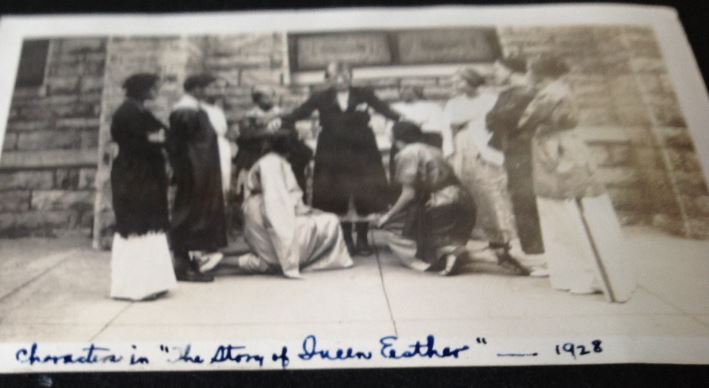
Character in "The Story of Queen Esther" - 1928

 
So, what do I wish?  I wish I had known my Grandmother longer.  I wish I could have seen the thespian side of her; the mischievous and playful side of her.  In these photos, she looks like she is having fun and enjoying life.  I wish, in the near future, to encourage my mom, aunts and uncle to share some of their memories of 'this side' of their mom - my Grandmother.

My Grandmother passed away 38 years ago and I still miss her terribly; she and the other ancestors are why I am so passionate about genealogy and family history.  My deep desire is for my children to KNOW each of them; the only thing that could have been better, is if they could have KNOWN each of them.

Menu for Wedding Reception


26 April 2013

Family Recipe Friday - Mush

It's funny how children who grow up eating a certain dish - a mainstay or 'go to' meal - from a very young age, they begin to associate that dish / meal with their family.  What I mean is, they begin to think that it is unique to them and their family.  When that family is from an area known for a particular ethnicity and the child's family also has that ethnicity within their lineage, it isn't a far leap for that child, as they grow older, to believe that not only is that certain dish unique to their family, but it IS of that enthnic culture that they descend from.  So, it was for me.

Background:  I grew up in rural Pennsylvania, about 1-1/2 hours north east of Philadelphia.  My Grandfather, Wilmer KRIEBEL (German descent) was born and raised in Graterford, Pennsylvania.  After marrying my Grandmother, they settled and made their home in Schwenksville, Pennsylvania.  Graterford was also home for myself and my parents.  Mennonites, of German descent, were our neighbors and Lancaster, Pennsylvania, known for its Amish population wasn't far from the area where we lived.  When family and friends gathered, 'Pennsylvania German' always seemed to be a common thread.

Somewhere along the way, I grew to believe that mush was an indigenous dish of the Pennsylvania Germans; that it was unique to my Grandfather's heritage and to our family.  And, I didn't learn otherwise until well into adulthood.  Recently I shared the story of my genealogy addiction; truth be told, I have another addiction, the Food Network, it was through watching their programming that I saw different recipes using cornmeal (the main ingredient of mush) and how different ethnic cultures used that grain by-product in their cuisines.  The Italians often eat Polenta (cornmeal) as a side dish; in soft form (siilar to mashed potatoes) and served most often with tomato gravy.  And, to my surprise, they also eat it fried.  The polenta is cooked then poured out onto a cutting board and left to set up, it is then sliced and either grilled or fried.  This discovery led me to 'consult' Google to see how other ethnic groups used cornmeal in their cuisine.

Cornmeal is used in kitchens all over the world; in theory, I knew this, but I am discovering that many cultures / ethnic groups have food products / recipes similar to the fried mush that I grew up eating.  This, I didn't know.  What follows is just a small sampling of what I learned during my research . . .

  • Mush (Coosh) - named for its Canadian inventor; Malcolm "Malcolmush" King.  Thick cornmeal pudding or porridge traditionally boiled in clam juice, water or milk.  It is often allowed to set to become semi-solid then sliced and pan fried.  Source:  http://en.wikipedia.org/wiki/Mush_(cornmeal)
  • Poudine Mais (Mauritus Island, Indian Ocean) - thick cornmeal / polenta pudding poured into a shallow buttered serving dish that has been lined with coconut and raisins.  Once set, it is sliced and enjoyed.  Source / recipe:   http://inspiredtobake.wordpress.com/2010/02/17/poudine-mais-simple-is-beautiful/
  • Sadza (Zimbabwe) - thickened porridge made with white cornmeal; usually served in a communal bowl or on separate plates, rolled into a ball, dipped into meat, gravy, sour milk or stewed vegetables.  A thinner version is made with peanut butter or margarine and eaten in the morning.  Source:    http://en.wikipedia.org/wiki/Sadza
  • Mamaliga (Romania / Moldova) - thick porridge made with cornmeal and may also include:  milk, butter, cheese, eggs, sausage, bacon, mushrooms, ham, or fish.  Source:   https://en.wikipedia.org/wiki/M%C4%83m%C4%83lig%C4%83

And, in the Americas; specifically the United States . . .

It has been around in one form or another since corn has been growing in the Americas.  During the Civil War, both the Confederate and Union armies ate cornmeal mush from time to time when supplies were scarce.  It was well known in the east as being a food primarily eaten by lower income households.  And, on the frontier, one ate what was available or one starved.  Source:  http://www.wisegeek.com/what-is-cornmeal-mush.htm

Below, written in my Grandmother's own hand, is the recipe for Mush.  It was my Grandmother's 'go to' recipe for many Sunday evening suppers, but we also enjoyed it on many an occassion for breakfast.  We all had different ways of enjoying the fried slices; I would eat mine with Grandma's Molasses, others ate it topped with jam or jelly, dusted with powdered sugar or topped with butter and syrup.


Catherine 'Kate' (STARR) KRIEBEL's Mush Recipe


Cornmeal mush, once eaten as a source of sustenance here in the United States, and still a mainstay in cuisines all over the world, can now be found in its various forms in recipes of famed chefs and in fine restaurants.  How cool!  Although, I never needed to be told that it was good eats.  I already knew; I've been eating it since I was knee-high to a grasshopper - what made it the best was that it was lovingly prepared by my Grandmother.  And, it didn't hurt that I thought it was unique to my family.  LOL!

A (near) future goal - to have fun trying the many ethnic variations I've discovered in the course of my Google research to learn more about cornmeal mush.  Although, I have no doubt that they will be delicious in their own rite, they will NEVER compare with my Grandmom's fried mush.

T

PS:  A happy aside - my oldest son phoned while I was putting this blog post together and requested this recipe. I happily shared it with the next generation; I look forward to more memories being made.  My Grandmother's food continues to be made with love and enjoyed.